Research

Spiroligomers — also known as bis-peptides — are synthetic oligomers made by coupling pairs of bis-amino acids into fused ring systems. Their conformational rigidity lets us program three-dimensional shape and position functional groups with atomic precision.

Synthesis Structure Catalysis Protein binding Metal binding Membranes Scaffolds

Overview

Shape-programmable macromolecules

Spiroligomers are built by coupling pairs of bis-amino acids into a fused ring system. Because a wide range of bis-amino acids can be incorporated during synthesis, these molecules carry rich stereochemistry, and their conformational rigidity gives them predictable, designable three-dimensional shapes — the basis for rational molecular modeling and design.

As peptidomimetics, spiroligomers are completely resistant to proteases and are unlikely to provoke an immune response, making them attractive scaffolds for biological and materials applications alike.
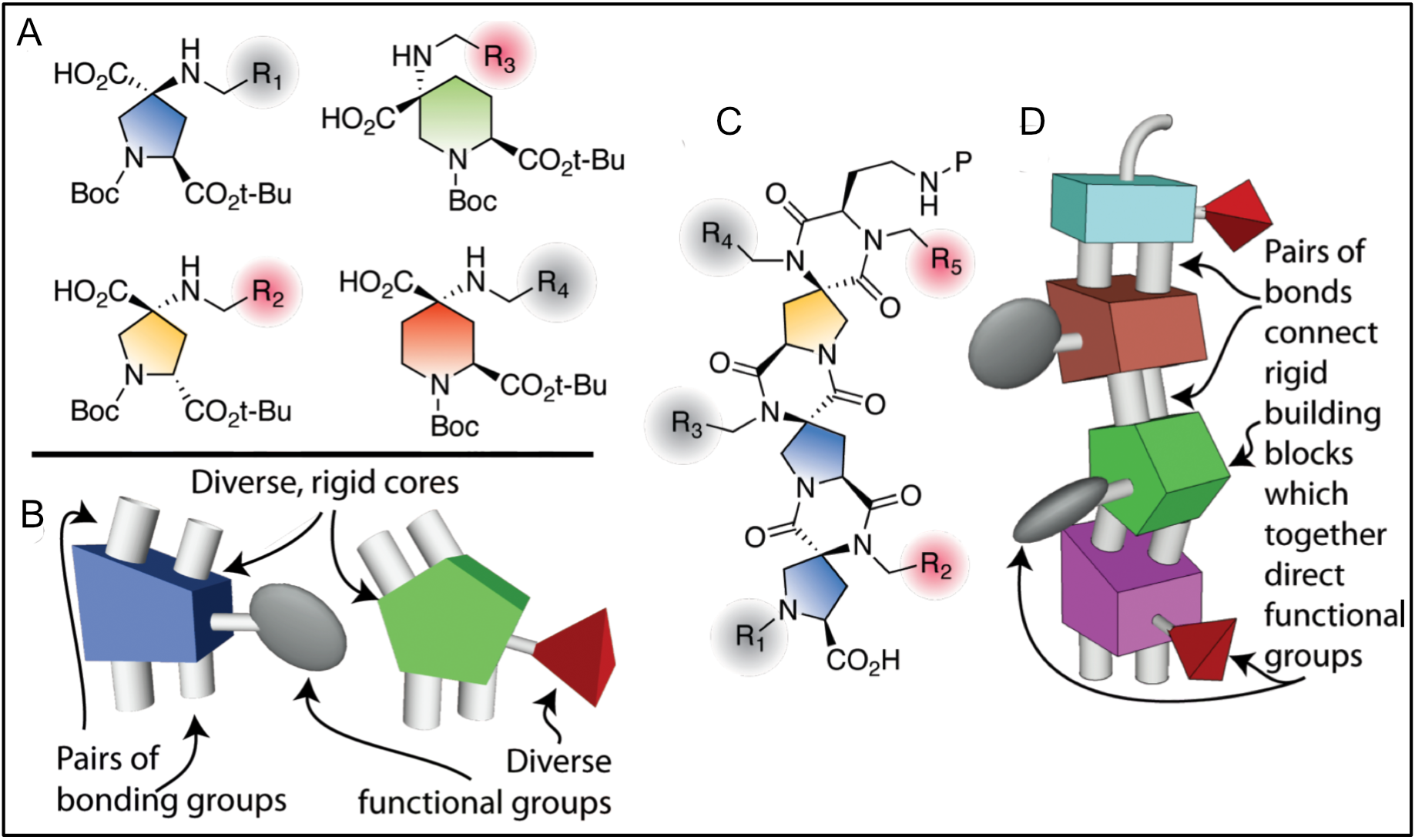
Spiroligomer scaffolds: bis-amino acids and a spiroligomer trimer, with 3D models
Spiroligomer scaffolds: (A) bis-amino acids, (B) 3D model of a bis-amino acid, (C) a spiroligomer trimer, (D) cartoon of a spiroligomer.
Synthesis

Stepwise, stereochemically controlled synthesis

Spiroligomers are assembled stepwise, adding a single bis-amino acid at a time, which gives complete control over stereochemistry. Both solution-phase and solid-phase routes are possible.

Early methods functionalized only the ends of an oligomer; later advances enabled functionalization of the interior diketopiperazine nitrogens. By exploiting an inherent neighboring-group effect of α-amino acids, spiroligomers can be synthesized bearing a variety of functional groups along the length of the molecule.

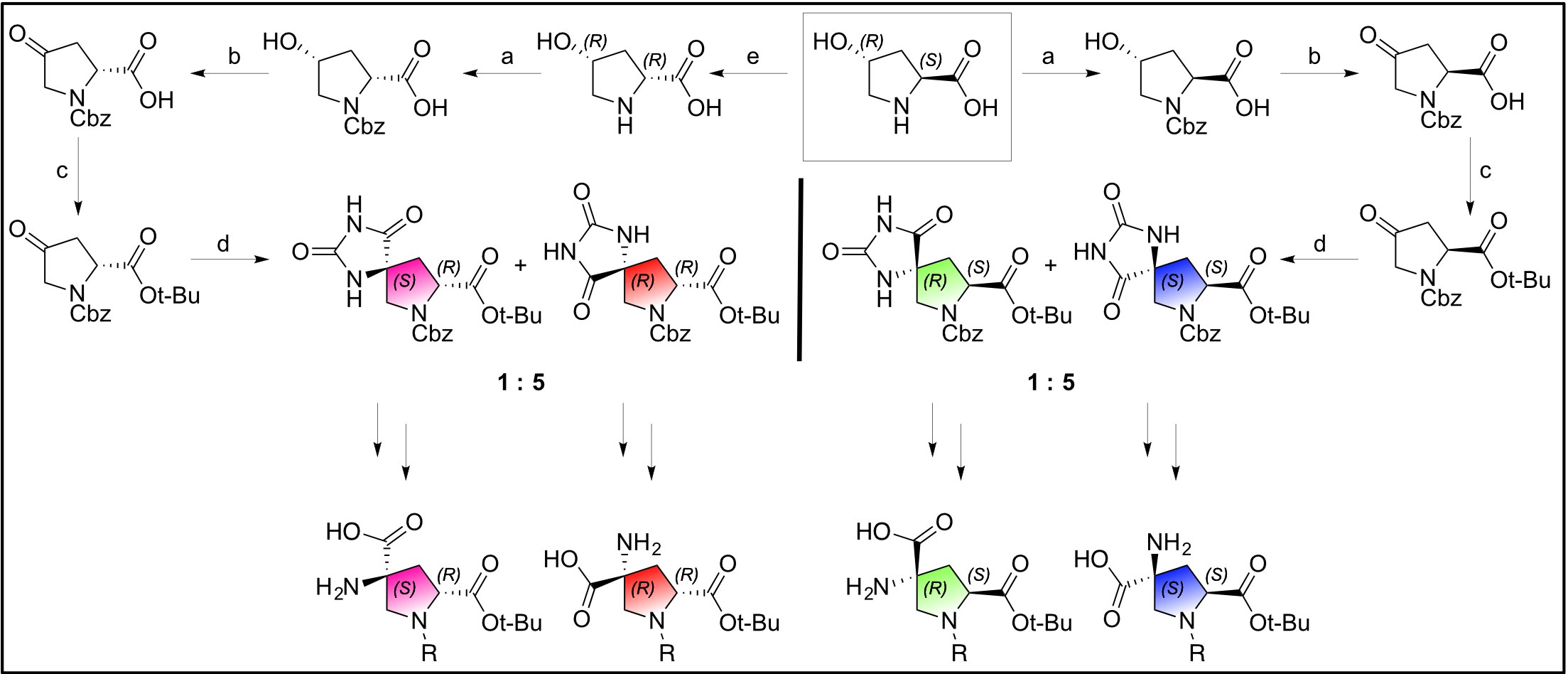
Synthesis of spiroligomer building blocks (bis-amino acids)
Synthesis of spiroligomer building blocks (bis-amino acids), with reagents and conditions.
Structure

Rigid, fused-ring backbones

Spiroligomers can be synthesized bidirectionally between any pair of bis-amino acids, with diketopiperazines (DKPs) formed at either terminus. The fused-ring architecture makes the backbone conformationally rigid, so the molecule holds a defined shape.

There are three common ways to connect the building blocks, all through pairs of amide bonds (diketopiperazines), giving access to curved and linear structures from a minimal set of monomers.

Three common ways of connecting spiroligomer molecules through diketopiperazines
Three common ways of connecting spiroligomers through pairs of amide bonds (diketopiperazines, DKPs).
Macromolecules

Spiroligomer macromolecules

To reach the size and functional density of proteins, we assemble spiroligomer building blocks into larger macromolecules. In our spiroligomer–peptoid hybrids, a rigid spirocyclic core preorganizes functional groups in three-dimensional space while a peptoid segment links them together — with careful design, the structured Spiroligomer segments can fold against each other to create nanostructures reminiscent of small proteins.

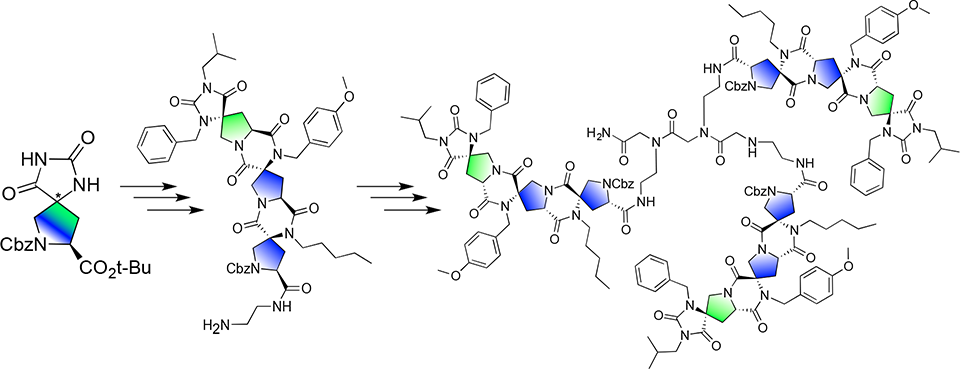
Starting from a common hydantoin building block, we synthesized 15 new spiroligomer monomer amines (each with two stereocenters and three functional groups) and a spiroligomer trimer bearing six stereocenters and five functional groups. Coupling these through standard peptoid synthesis yields hybrids such as SPH-5, a first-generation spiroligomer–peptoid hybrid that displays 12 functional groups across 18 stereocenters on a single preorganized scaffold.

Synthesis progression from a hydantoin building block to a spiroligomer trimer to the spiroligomer–peptoid hybrid SPH-5
From a hydantoin building block (left) to a spiroligomer trimer to the spiroligomer–peptoid hybrid SPH-5 (right), which presents 12 functional groups over 18 stereocenters. Adapted from Northrup et al., J. Org. Chem. 2017, 82, 13020–13033.

Applications

Where atomically precise design changes what's possible.

Catalysis

Spiroligozymes — designed catalysts

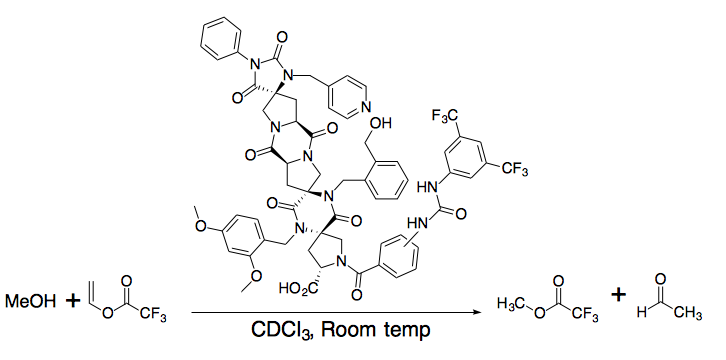
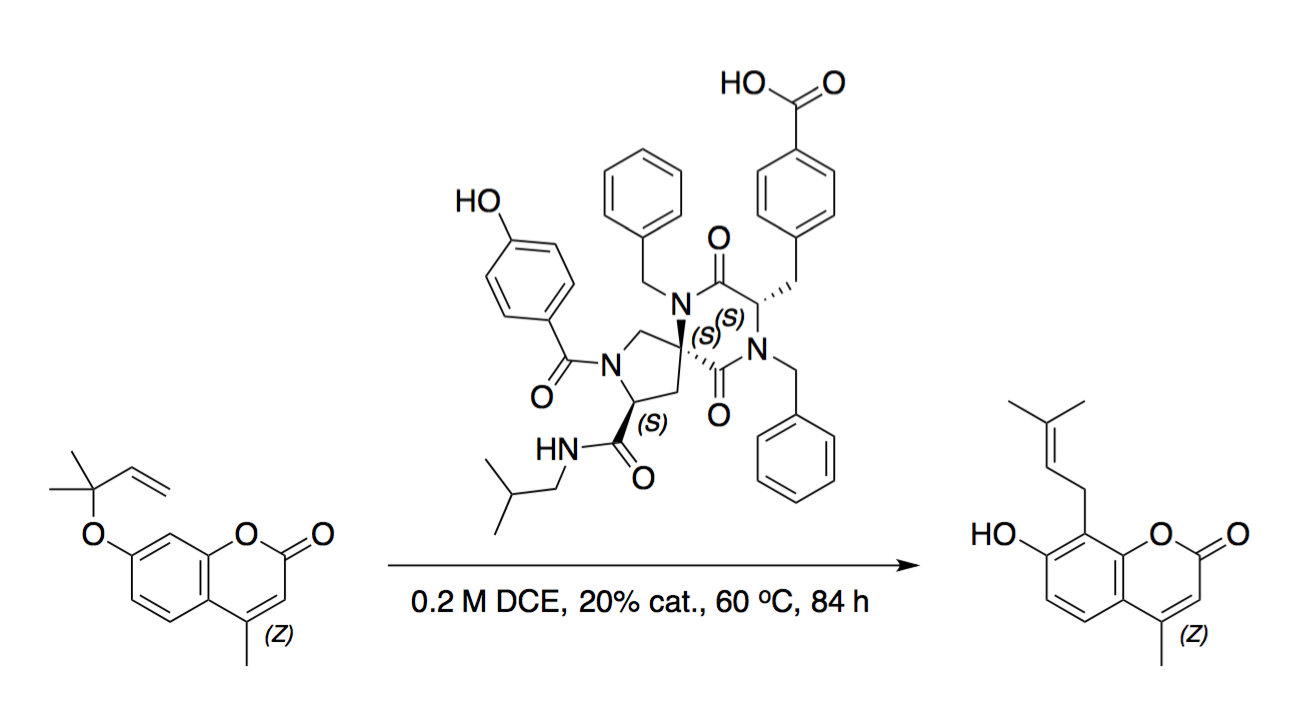
By positioning catalytic groups on a rigid scaffold, we build spiroligozymes: synthetic catalysts designed from geometry rather than screening. Two families have been developed — an esterase mimic that catalyzes transfer of a trifluoroacetate group, and a Claisen catalyst that accelerates an aromatic rearrangement using a catalytic dyad reminiscent of ketosteroid isomerase.

Transesterification of vinyl-trifluoroacetate with a spiroligozyme
Transesterification of vinyl-trifluoroacetate with a spiroligozyme.
Aromatic Claisen rearrangement with a spiroligozyme
Aromatic Claisen rearrangement accelerated by a spiroligozyme.
Protein binding & therapeutics

Engaging protein targets inside cells

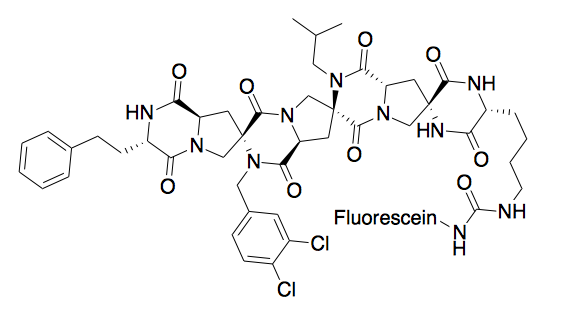
Spiroligomers can be designed to mimic the key features of a protein surface. A spiroligomer α-helix mimic designed to imitate p53 binds HDM2, passively diffuses into human cells, and stabilizes HDM2 in cell culture — demonstrating that these scaffolds can disrupt protein–protein interactions relevant to disease.

Spiroligomer that penetrates cells and binds HDM2
A spiroligomer that penetrates cells and binds HDM2.
Metal binding

Templating binuclear metal complexes

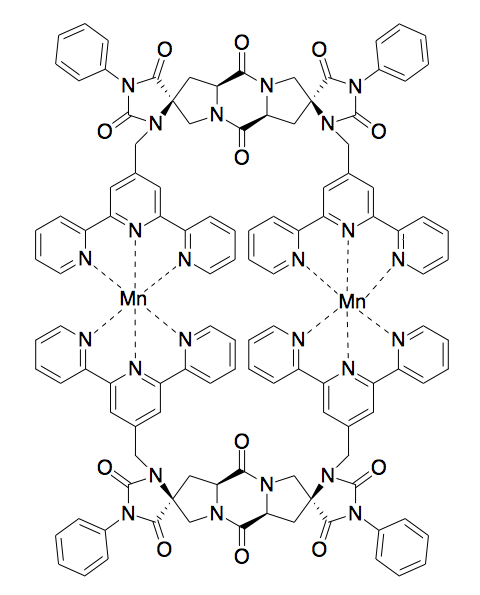
Architectural spiroligomers can be designed to bind two metal centers at once. Binuclear complexes have been built that simultaneously coordinate manganese and zinc, positioning the metals with the precision the rigid scaffold provides.

A spiroligomer that binds manganese and zinc
A spiroligomer designed to bind manganese and zinc.
Atomically precise membranes

Membranes with atomically precise pores

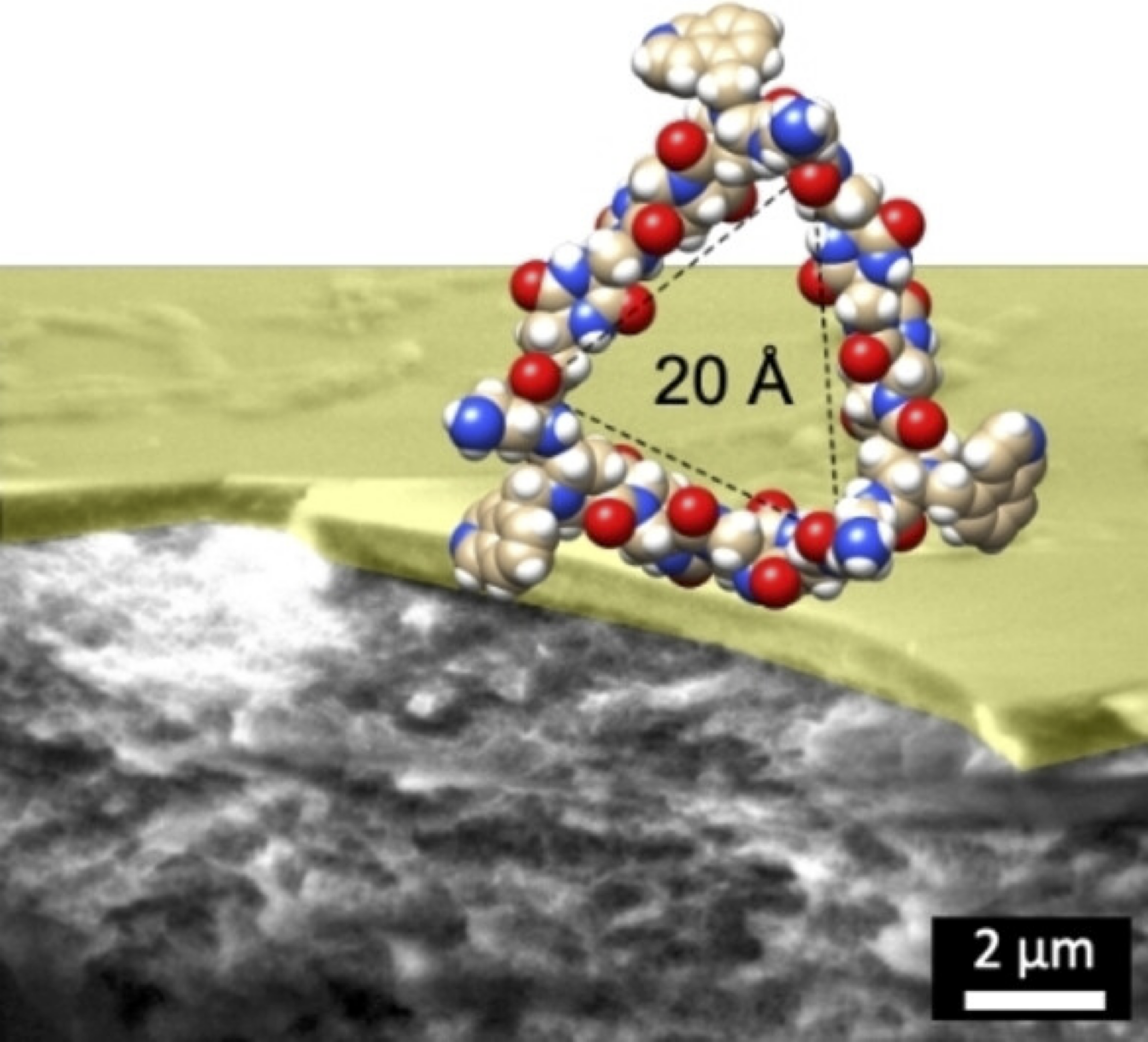
Cyclizing multiple spiroligomer segments produces peptidomimetic macrocycles with well-defined three-dimensional structures and low conformational flexibility, assembled by modular solid-phase synthesis. Rigid spiroligomer walls linked by flexible amino-acid hinges give each macrocycle an inner cavity that cannot collapse.

Triangular macrocycles of tunable size can be crosslinked into two-dimensional sheets — membranes whose pores are atomically precise. These membranes show size- and shape-dependent molecular sieving across a series of structurally similar compounds, pointing toward highly selective separation and filtration at the molecular scale.

Triangular spiroligomer macrocycle with a 20 Ã… pore, shown on an SEM cross-section of the membrane
A triangular spiroligomer macrocycle with a 20 Å pore, shown above an electron-microscope cross-section of the membrane it forms (scale bar 2 µm). From Xie et al., Angew. Chem. Int. Ed. 2023, 62, e202302809.
Scaffolds, sensing & beyond

Molecular rulers, electron transfer, and molecular machines

The rigidity of spiroligomers makes them excellent molecular scaffolds. As distance-measuring "molecular rulers," end-labeled spiroligomers with spin probes report defined distances by electron spin resonance. In donor–bridge–acceptor configurations, they enable studies of electron transfer — including evidence for water-mediated transfer through bis-amino acid bridges.

Looking ahead, potential applications include inactivating cholera toxin, cross-linking viral surface proteins (such as HIV and Ebola), and building molecular machines — molecular hinges, nanovalves, and data-storage systems.

Selected publications

  1. Schafmeister CE, Brown ZZ, Gupta S. Shape-Programmable Macromolecules. Accounts of Chemical Research 2008, 41(10), 1387–1398. doi:10.1021/ar700283y
  2. Brown ZZ, Schafmeister CE. Synthesis of Hexa- and Pentasubstituted Diketopiperazines from Sterically Hindered Amino Acids. Organic Letters 2010, 12(7), 1436–1439. doi:10.1021/ol100048g
  3. Bird GH, Pornsuwan S, Saxena S, Schafmeister CE. Distance Distributions of End-Labeled Curved Bispeptide Oligomers by Electron Spin Resonance. ACS Nano 2008, 2(9), 1857–1864. doi:10.1021/nn800327g
  4. Brown ZZ, Alleva J, Schafmeister CE. Solid-Phase Synthesis of Functionalized Bis-Peptides. Biopolymers 2011, 96(5), 578–585. doi:10.1002/bip.21591
  5. Levins CG, Schafmeister CE. The Synthesis of Functionalized Nanoscale Molecular Rods of Defined Length. Journal of the American Chemical Society 2003, 125(16), 4702–4703. doi:10.1021/ja0293958
  6. Brown ZZ, Schafmeister CE. Exploiting an Inherent Neighboring Group Effect of α-Amino Acids to Synthesize Extremely Hindered Dipeptides. Journal of the American Chemical Society 2008, 130(44), 14382–14383. doi:10.1021/ja806063k
  7. Kheirabadi M, Schafmeister CE, et al. Spiroligozymes for Transesterifications: Design and Relationship of Structure to Activity. Journal of the American Chemical Society 2012, 134, 18345–18353. doi:10.1021/ja3069648
  8. Parker MFL, Schafmeister CE, et al. Acceleration of an Aromatic Claisen Rearrangement via a Designed Spiroligozyme Catalyst Mimicking the Ketosteroid Isomerase Catalytic Dyad. Journal of the American Chemical Society 2014, 136(10), 3817–3827. doi:10.1021/ja409214c
  9. Brown ZZ, Akula K, Schafmeister CE, et al. A Spiroligomer α-Helix Mimic That Binds HDM2, Penetrates Human Cells, and Stabilizes HDM2 in Cell Culture. PLoS ONE 2012, 7(10), e45948. doi:10.1371/journal.pone.0045948
  10. Vaddypally S, Xu C, Zhao S, Fan Y, Schafmeister CE, Zdilla MJ. Architectural Spiroligomers Designed for Binuclear Metal Complex Templating. Inorganic Chemistry 2013, 52, 6457–6463. doi:10.1021/ic4003498
  11. Chakrabarti S, Parker MFL, Morgan CW, Schafmeister CE, Waldeck DH. Experimental Evidence for Water-Mediated Electron Transfer Through Bis-Amino Acid Donor–Bridge–Acceptor Oligomers. Journal of the American Chemical Society 2009, 131(6), 2044–2045. doi:10.1021/ja8079324
  12. Levins CG, Schafmeister CE. The Synthesis of Curved and Linear Structures from a Minimal Set of Monomers. Journal of Organic Chemistry 2005, 70, 9002. doi:10.1002/chin.200605222
  13. Northrup JD, Mancini G, Purcell CR, Schafmeister CE. Development of Spiroligomer–Peptoid Hybrids. Journal of Organic Chemistry 2017, 82(24), 13020–13033. doi:10.1021/acs.joc.7b01956
  14. Xie Y, Luo D, Wiener JA, Koval AB, Pfeiffer CT, Schafmeister CE. Spiroligomer-Based Macrocycles for Atomically Precise Membranes. Angewandte Chemie International Edition 2023, 62, e202302809. doi:10.1002/anie.202302809